


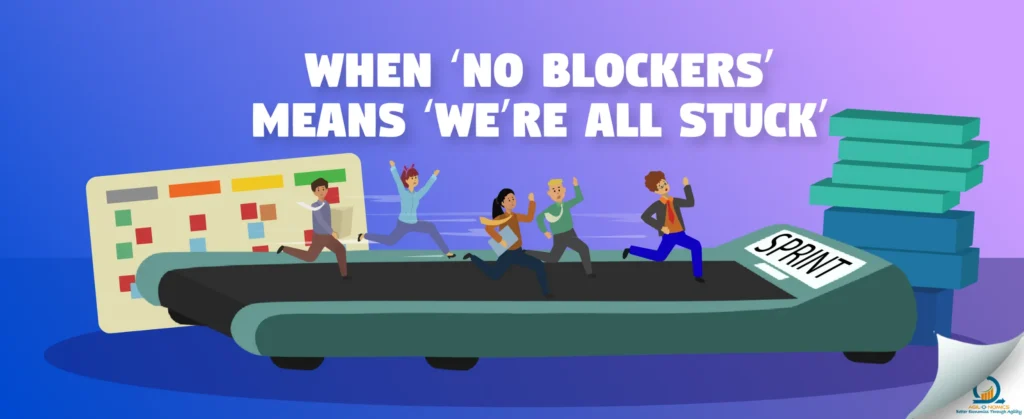
Every day, across thousands of teams, the phrase “No Blockers” gets repeated like a badge of efficiency. It signals smooth progress — a sprint in motion, work on track, everything under control. But what happens when the team keeps saying “No Blockers” and still cannot move forward?
That’s when the phrase stops being a status and starts being a signal — one we often ignore.
Teams rarely grind to a halt because of one clear impediment. More often, the real obstacles live in the gray areas: half-decisions, unclear goals, unspoken concerns, and dependencies no one mentions out loud. These are the blockers that do not fit neatly into a board or ticket. They live in the space between conversations.
The Illusion of Smooth Progress
Daily check-ins are meant to create visibility, not measure performance. But over time, standups can turn into routines — a quick round of updates where people talk at the process, not to each other.
When a team says “No Blockers” day after day, it can mean one of three things:
- They are moving perfectly in sync — rare, but possible.
- They are unaware of what’s slowing them down.
- They do not feel safe enough to say what’s really blocking them.
The last two are the silent killers of momentum. And ironically, they’re the ones most teams never discuss.
The Hidden Cost of Silence
Silence feels safe. It avoids friction, saves time, and keeps the rhythm of delivery intact. But silence also hides learning opportunities. It prevents teams from challenging assumptions, asking for help, or clarifying direction.
A team that reports “No Blockers” might actually be one step away from burnout — still working hard, still pushing forward, but disconnected from purpose and clarity. They’re moving, but not aligning. Delivering, but not improving.
The most effective teams use their check-ins not to report, but to reveal. They know that saying “I’m blocked” is not a weakness — it’s an act of trust. It means the process works, the team listens, and support is available.
Redefining What Progress Looks Like
Progress is not just about completing tasks. It’s about learning together — adapting, adjusting, and removing friction as a unit. When the team avoids surfacing real blockers, they also avoid the conversations that refine their process. Over time, this creates a quiet drift — the team keeps delivering, but the work loses its sharpness and shared intent. True progress happens when every challenge becomes a moment of alignment, not avoidance — when the discussion itself drives improvement, not delay.
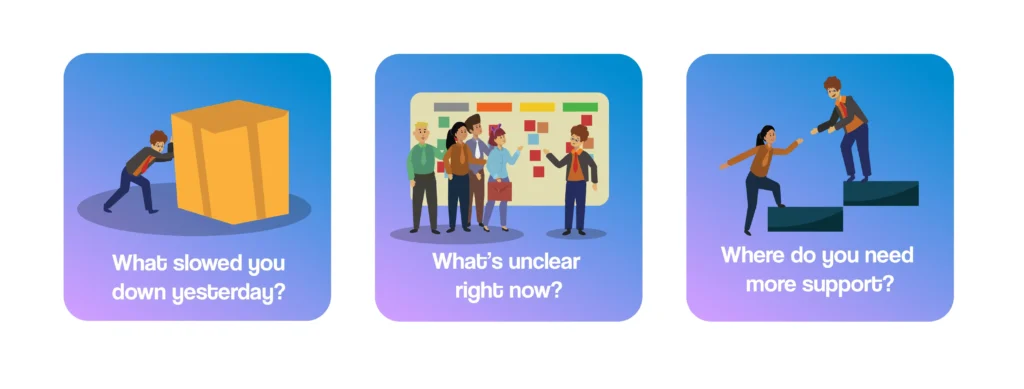
Leaders and Scrum Masters have a critical role here: to make vulnerability visible. Ask questions that go beyond the checklist:
- What slowed you down yesterday?
- What’s unclear right now?
- Where do you need more support?
These questions shift focus from status to insight. They turn the standup from a formality into a space for awareness and connection — the foundation of real agility.
The New Meaning of “No Blockers”
Maybe the goal is not to eliminate blockers entirely. Maybe the goal is to build teams that can talk about them openly — that see friction as feedback, not failure.
When teams treat “No Blockers” as an opportunity to check their alignment, not their speed, they uncover what really drives sustainable delivery.
Because progress is not silence. It’s conversation.
It’s the courage to pause, to question, to admit what’s not working — before it turns into delay.
So the next time everyone says “No Blockers,” listen closely.
It might mean the team is fine.
Or it might mean the team has stopped talking about what truly matters.
This post combines the author’s personal thoughts, ideas, and experiences, with some refinement provided by our Agile Bot AgiNomi.