


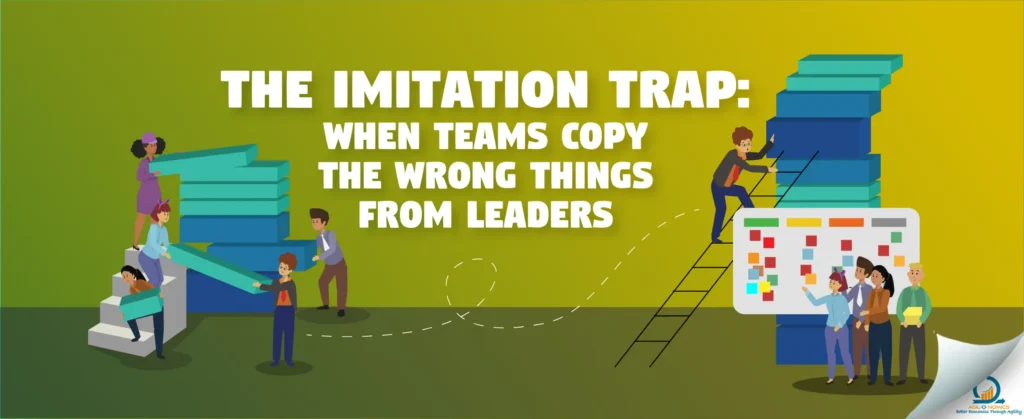
Influence is not optional — it’s automatic. The question is what gets replicated.
The Imitation Trap happens when teams unconsciously mirror their leaders — not their best intentions, but their daily actions, reactions, and priorities. It’s rarely deliberate. People simply learn by observing what earns approval, what gets ignored, and what drives results. Over time, these patterns form the true culture of an organization — regardless of what’s written on the walls or presented in leadership slides.
What Teams Really Copy
Leaders often assume their teams mirror their vision or strategy. In reality, teams imitate behavior long before they internalize belief. When a leader rushes through meetings, others start to rush. When a leader avoids difficult conversations, so does everyone else. When a leader celebrates output over learning, the team quickly learns what really matters.
This is the Imitation Trap — the quiet transference of habits that shape how people think, decide, and deliver.
It’s not the speeches or slogans that set the tone. It’s the everyday rhythm: how leaders respond under pressure, how they handle uncertainty, and how they treat people when nobody’s watching.
The Hidden Cost of Unexamined Influence
The Imitation Trap is not inherently negative. Imitation is how humans learn. The problem arises when leaders are unaware of what’s being imitated.
A manager who multitasks through meetings might believe they’re modeling efficiency. But the team sees distraction. A product owner who changes priorities mid-sprint might think they’re staying adaptive. The team experiences instability. Even well-intentioned leaders fall into this trap when urgency overshadows clarity.
And, it can be costly. Teams begin to reflect inconsistency instead of alignment. They mirror busyness instead of focus. And the longer this continues, the harder it becomes to trace problems back to their true source.
Breaking Free from the Imitation Trap

Escaping the Imitation Trap starts with awareness. Leaders must recognize that their smallest actions carry the most weight. A shift in tone, a delayed response, or a visible reaction can reinforce or reshape culture in real time.
It begins with three questions every leader should ask:
- What behaviors in my team look familiar — and why?
- Are they reflecting my best practices or my blind spots?
- What signals do my decisions send, even when I say nothing?
Once awareness sets in, change can follow. Model the behaviors you want repeated — patience, clarity, curiosity, respect, and above all centeredness amidst chaos. Demonstrate learning by example, not by mandate. When leaders own their mistakes publicly, they make accountability safe for everyone else. When they pause to listen instead of reacting, they teach the team to think before it moves.
Building Intentional Influence
Great leadership is not about control; it’s about conscious influence. The leaders who create lasting impact are those who understand that culture is not built through communication plans — it’s built through observation and repetition.
Every hallway conversation, sprint review, or quick decision becomes a lesson in what the organization truly values. The best leaders use that awareness intentionally, turning everyday moments into examples of focus, empathy, and adaptability.
The real measure of leadership is not how people act when they’re being watched — it’s how they act when they’re not. That reflection tells the story of influence done right.
The Bottom Line
The Imitation Trap reminds us that leadership is not about managing tasks — it’s about managing examples. Influence spreads faster than intention. Teams don’t just follow direction; they follow demeanor.
So, the question is not whether your team imitates you — they already do.
The question is: what exactly are they learning from you every day?
This post combines the author’s personal thoughts, ideas, and experiences, with some refinement provided by our Agile Bot AgiNomi.