Why SAFe Training and Certification are Important?

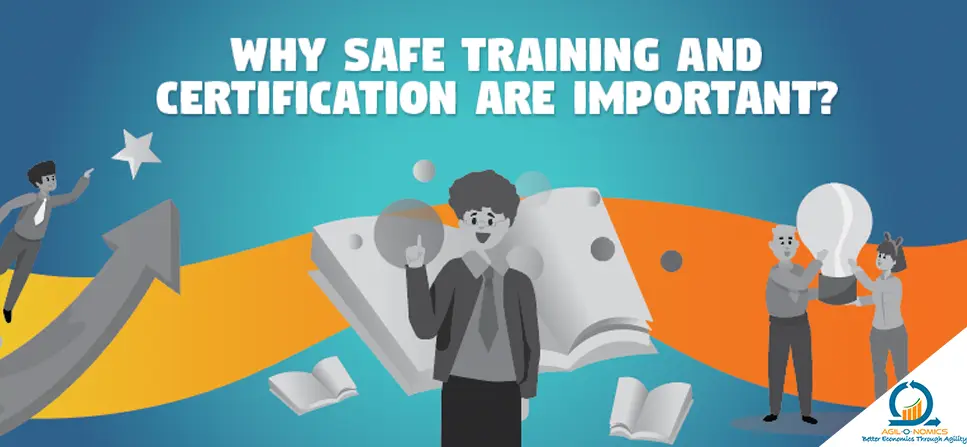
Why SAFe Training and Certification are Important?

SAFe training and certification are quite popular today. They are important for anyone who is seeking to work in an environment implementing Agile at Scale. The SAFe concepts will not only come in handy at a large number of companies that have embraced SAFe implementation but will also be beneficial if deeper understanding of these concepts (e.g. SAFe LPM) can be applied in a practical manner to places that want to scale their homegrown organic Agile implementation. Additional reasons why SAFe training and certification can contribute to your success Scaling Agile in a Structured way: SAFe is a structured framework that helps large sized organizations become effective in applying Agile across many teams. The structured setup, processes and practices aligns everyone and guides them to move in the same direction with common goals. Better Career Opportunities: As demand for SAFe (especially in large organizations) is high, the need for SAFe certified personnel is also high in demand. SAFe certification can therefore boost your career prospects. It can help you stand out in a competitive job space and open up opportunities like SAFe Scrum Master, SAFe Product Owner, SAFe Product Manager, SAFe Release Train Engineer, SAFe Developer, and more. Deeper Understanding of Lean-Agile Principles: SAFe training will help you under the deeper aspects of Lean Agile Principles and their effective application in practical real world scenarios. This will empower you to drive outcomes impacting productivity, quality, speed-to-market and organic cost-reduction. High Performing, Collaborative Teams: Alignment, Transparency and Collaboration are encouraged and emphasized in SAFe. Proper training from people who breathe, live, love and work(daily) hands on at enterprises helping implement Agile and SAFe effectively will ensure all Agile team members from developers to executives will be on the same page. This will result in improved team performance and satisfaction. Practical learning from Industry Experts: Training and certifying with coaches who have worked hard over the years to succeed with Agile, will help you receive practical, hands-on learning from experts. Such a real-world experience is priceless and will help you apply your understanding to effectively implement SAFe in your organization. Continuous Learning, Inspection and Adaptation: The modern work landscape is continuously evolving. SAFe training encourages continuous learning and adaptation and enables you to stay up-to-date with the latest trends and practices that work. Don’t embark on a SAFe training and certification to get a stamp, but to enhance your skills, improve your career prospects through deeper understanding of principles and their application and drive meaningful change in your organization. Invest in SAFe training and certification from people who don’t train and certify to just make a living but do so to also share their passion and success in implementing Agile and SAFe over many years. Learn from their experiences – both success and failures – and grow into an effective and impactful Agile professional.
Why SAFe Training with Agilonomics

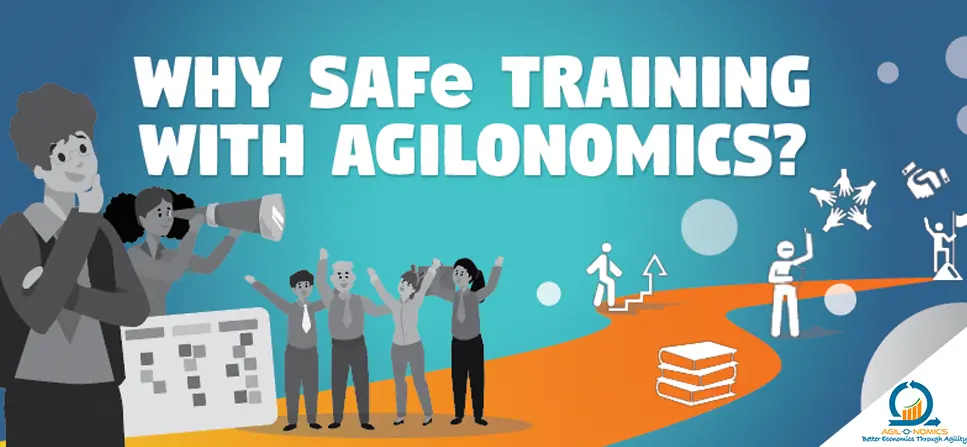
Why SAFe Training with Agilonomics?

SAFe(Scaled Agile Framework) is more than just a framework. Many consider it heavy-weight. We feel it is a comprehensive approach for guiding Agile practices to scale across an organization. The demand for SAFe expertise continues to rise. It is important, therefore, to invest in high quality training and coaching to empower yourself on how to navigate the complexities of implementing SAFe effectively. Here is why choosing Agilonomics for your SAFe journey will make all the difference. All Round, Hands-on Expertise:SAFe is well known to be heavy and complex. Theoretical knowledge alone isn’t enough to navigate through its intricacies. When you learn with Agilonomics, you get much more than just a certification. You’re investing in gaining insights from seasoned practitioners who have helped many clients (Fortune 100 – Startups) to succeed with SAFe and Agile. Our trainers bring a collective experience spanning well over 1000s of hours – coaching and training – to ensure you receive practical insights to current and real-world challenges Advance In Your Career:Many take certification for getting a badge. It only helps you go so far. In today’s competitive world, investing in training from a trusted provider who understands the game inside out, will not only get you the certification but also help in your career advancement. Choosing Agilonomics will equip you with the skills, insights and confidence to drive successful SAFe transformations. You will gain the ability to grow into a sought after Agile and SAFe transformation leader. Hands-On Learning:Only way to succeed with SAFe is to move beyond theory to deeply understand how to apply its principles in fast paced, complex environments. Engaging with Agilonomics, you will be exposed to hands-on experience with practical real-world challenges and gain the ability to develop powerful solutions and strategies. Our training underscores the importance of collaboration, one-team-attitude, problem-solving and adaptability to ensure you’re well equipped to tackle the complexities of Scaling Agile. Sharing Client Success Stories:We, at Agilonomics, measure our success by the success of our clients. Our coaches and trainers have helped organizations like Sony PlayStation, Blue Shield of CA, At&T, among others, to achieve remarkable results with implementing SAFe through our training and coaching programs. Agilonomics’ Commitment to Excellence:Our purpose is to create greatness in the corporate world, one person, one company at a time. So, we’re committed to excellence in everything we do. This shows up in the quality of our training and the expertise of our trainers. We strive to uphold the highest standards to ensure your learning experience is exceptional. With us, you’re not just investing in training but investing in a partnership that is committed to help you succeed Your choice of SAFe training with Agilonomics is more than just a decision. It’s a strategic investment that will help you grow professionally, and succeed in your career. Our comprehensive knowledge, hands-on experience in many industries, and commitment to excellence will empower you on your SAFe journey every step of the way. Ready to move forward in your journey?

Agile and AI Development: Bridging Complexity with Flexibility

Why Agile with AI is Important Today? The world of technology is changing as always. Many feel threatened today with the impact of Artificial Intelligence (AI) on their jobs and career. Agile is not spared either. However, building AI products is complex and integrating Agile ways of working with AI development is crucial for organizations to stay competitive. Agile mindset of flexibility and iterative development matches up perfectly for handling complexities and uncertainties inherent to AI development. AI projects often involve a lot of experiments, ongoing learning, frequent changes or adjustments based on emerging data and insights. Agile methodologies promote adaptability, collaboration, and continuous improvement. They provide a lightweight structured framework and are well suited to accommodate these dynamic requirements.By adopting Agile principles and truly understanding their application, organizations can effectively manage the iterative cycles of AI product development. This will help with timely delivery of innovative and valuable AI solutions while staying adaptable to new information and changing markets. This teaming up of Agile and AI will boost the success of AI projects by driving innovation, efficiency, time-to-market and ultimately impacting business value. Why AI Development is Challenging? Developing AI products brings unique challenges to the table; challenges that set them apart from traditional software projects. Here are some common challenges that I see often with AI Despite the above challenges, AI projects have immense potential for success and will bring in high return on investment. They already are, and will continue to shape the future of technological innovation and human evolution.Organizations that effectively tackle these challenges will harness the transformative power of AI to create solutions that will drive innovation, speed-up decision making, and offer competitive advantages. However, to achieve success will need a flexible, adaptive and collaborative mindset that translates to behaviors and practices that can effectively manage the complexities and uncertainties inherent to AI product development. This is where Agile comes into play with its empiricism, inspect and adapt, customer focus, systems thinking on one hand and servant leadership, collaboration, swarming, attention to results, commitment, team ownership (accountability), healthy conflict and foundation of trust on the other (hand). These two sides of Agile can provide a structured, adaptable and safe ground for making AI projects thrive! How Can We Help You? Hernan Tocuyo, my peer Coach and I, worked for a year at a client where we were onboarded with bringing their DATA ART (Agile Release Train) to become effective and high performing. Multiple teams in that ART are engaged in high complexity work, including AI, Machine Language, Data Science, Data Engineering etc. They develop algorithms, test hypotheses, and build models. Their work includes enablers, spikes, and needs cross coordination between domain experts and across ARTs. They use all industry standard data management tools such as Teradata, Apache, Databricks, Hadoop, Informatica, Tableau etc. Using Agile values and Agile and SAFe principles we brought all teams to a high level of effectiveness in a very short time. They figured out better ways to write stories, have conversations, refine work, collaborate and make their PI planning effective. Some data scientists paired with us and brought out an effective way to write their Data Science stories and created and continuously polished templates that everyone could use. Inspired by our work with them and the collaboration between Agile Coaches and Data Scientists, we wrote a blog on this Conclusion: Agile done wisely and sensibly does work and works well enough. The teams from this above client have members across 4 time zones with very little overlapping hours. Despite this and other challenges, they have developed into effective, highly collaborative, high performing teams. The current AI wave is creating a lot of fear about “Agile is dead” and all the noise of Scrum Master jobs being taken away. I would call out to all the passionate Scrum Masters that AI will never be able to replace the need of human beings who inspire greatness in others, create safe environments to work and are true Servant Leaders serving their teams and organizations. Strive to be a powerful Servant Leader Scrum Master; truly imbibe the universal values and principles of Agile and Scrum and you will never find yourself out of job. There will always be a need for humans who can bring positive behaviors out in others through their caring attitude and inspire change for the betterment of an organization. We have done successful end-end organic Agile Transformations for multiple clients using two of the most popular scaling frameworks, Scaled Agile (SAFe) and Scrum@Scale. Contact us to learn how we did it for them. Due to huge success with onsite and client training, we started to offer both SAFe training and certifications and will be starting with Scrum Alliance training and certifications soon. In addition, Agilonomics’ own training workshops with certification are also available. Each of these is taught by an expert coach with many 100s of hours of training and hands-on coaching.

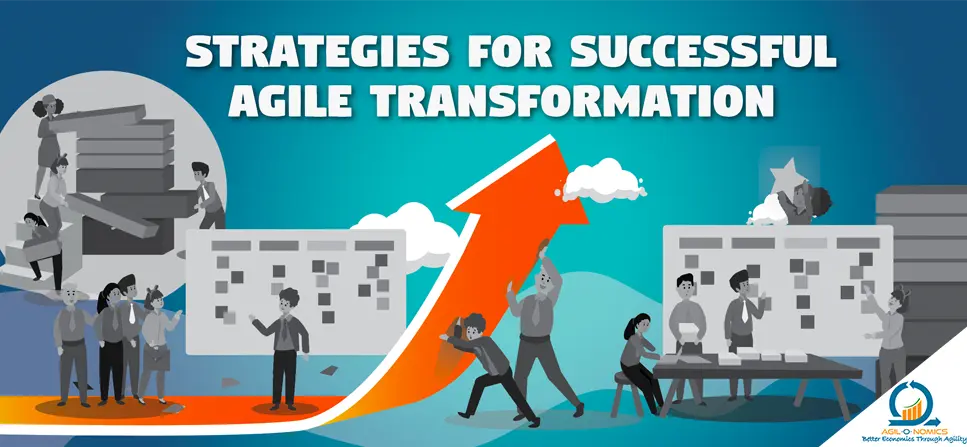
Strategies for Successful Agile Transformation

Strategies for Successful Agile Transformation

Introduction: What is Agile Transformation? Agile Transformation in simple words means creating effectiveness in teamwork through Agile Mindset that impacts behaviors and culture and organizes people into effective teams (as opposed to working groups)  to deliver high value to users and customers.  A wise Agile implementation will have these 3 characteristics: This is in contrast to bitwise, piecemeal or superficial transformations where teams and employees are expected to follow Agile but leadership behavior is unintentionally disruptive to the new ways of working. As a result, the larger unresolved cultural or environmental issues eventually contaminate or pollute the new Agile Teams. As a result people will be happier, healthier and wiser in their day-day work and interactions. Agile transformation is a continuous journey of cultural shift, where individuals, teams, and organizations evolve to become more adaptive, collaborative, and responsive. Why are Agile Transformations important? Enabling teams and individuals to operate at their best potential while delivering high value to the business is a desired goal of any organization. Agile principles in action help teams improve their responsiveness to customer needs, negotiate market shifts better, and expedite the delivery of high-quality products and services.  Wise Agile transformations cultivate safety, trust, and sustained growth among team members, while also promoting continuous improvement, empowerment for iterative processes, and a culture of learning and evolution.  The modern business landscape is complex and dynamic. Organizations must adopt Agile mindset and behaviors to remain competitive, flexible, innovative, and achieve faster time-to-market. Why do many Agile Transformations fail? Successful and effective Agile Transformation involves: As you can see, an effective Agile Transformation involves the whole village – individuals, teams, managers, leaders and executives. Everyone needs to show up and do their part to positively impact the mindsets, behaviors, culture and results! With this approach the Agile Transformation will not only be effective, but also long lasting and reflect in end-end behaviors (bottom-up and top-down). While all of the above is desirable and may seem easy on paper, it is very hard to achieve. The change agent Agile Coaches often lack necessary skills and fail to grapple with the demands of a holistic end-end Agile transformation. This highlights the importance of selecting Agile coaches who are solid in their foundations and exemplify strong purpose and core values. My Agile Journey: From Frustration to Discovery In my journey as the CEO and Co-Founder of Agilonomics, I’ve experienced the transformative power of Agile time and again. My journey started with a sense of frustration at a large enterprise where I found myself leading a group of people focused on waterfall practices. I vividly remember the days when we met as a team, usually once a week but hardly anyone spoke. Our manager would facilitate, share a few artifacts, ask for status updates and that was it. This was a routine mandatory gathering rather than a meaningful team collaboration session. Something was missing. I realized that we are just a working group and not a cohesive ‘team’. This realization made me research better ways of working. I had an open and honest conversation with my boss, where I expressed my concerns about the team lacking engagement and happiness. His initial response was surprising as he thought salary, bonuses and stocks alone made employees happy!? It took me a few sessions of hard but respectful conversations to help him realize that happiness for humans stems from meaningful connections and shared happiness. The result was permission to attend an Agile Developers Conference and bringing in Agile and Scrum to my team as an experiment to see if it helps boost collaboration, engagement, customer value and team happiness. My Experiment with Scrum I failed miserably at the beginning as team members grappled with new processes and practices. Interference from management dictating how to do Scrum was not helping either. I had to coach my boss to step aside and trust me to work with the team in establishing the process. He then partnered with me supporting and championing our team.  Building a Successful Agile Team Through perseverance, commitment and dedication, we transformed into a high-performing Agile team. The team behaviors reflected Agile values and principles. There was camaraderie, bonding, enthusiasm, warmth and collaboration among team members. The focus shifted from creating outputs to customer value. We committed to Sprint goals as “one team”, took accountability for all work and continuously improved our process through feedback and retrospection. Lessons Learned with Insights Organic Agile transformation begins with a focus on people. Engaging leaders, encouraging transparency and leading by example are important ingredients of a successful transformation. Embracing Agile values and principles, patience and striving for continuous improvement are some factors that contribute to successful transformation. Authenticity and purpose are foundational to effective Agile Leadership. Staying true to core values, striving to grow employees and genuinely caring for people can drive meaningful change. Establishing an Agile Practice Group and supporting a culture of continuous improvement are key to sustaining Agile transformation. By promoting human values and prioritizing transparency, accountability, and learning, organizations can navigate change with confidence and resilience. A final note on what kind of coaching is effective for Agile Transformations When selecting Agile Coaches, look out for the ones that standout with strong core values and purpose. An effective Agile Coach will go beyond just fixing processes to serve as a role model, bringing up greatness in individuals and teams. Coaches must remember that true transformations come from within and cannot be imposed from outside. Effective coaching includes leaders to be part of the transformation. No transformation can be complete by excluding leaders and managers who serve the teams undergoing Agile transformation.At Agilonomics, we offer a proven “Agile Transformation Blueprint” refined over two decades, facilitating impactful transformations across various organizations led by renowned servant leader coaches.

A RAMBLE ABOUT METRICS – ZACH BONAKER

MEASURING AGILE How will you show the progress of agile transformation? How will you measure improvement in teams and people? And how will you avoid the trap of shallow metrics like say:do ratios and velocity? Whether you’ve worked as a manager, coach, or consultant, you’ve likely experienced conflict and confusion over “agile metrics.” Traditional metrics which emphasize personal productivity drive negative behaviors, encouraging us to stay busy with tasks over working together to achieve goals. Meanwhile, leaders feel dissatisfied with popular “agile metrics,” such as velocity and burn-down charts, when they fail to provide the insights desired. This conflict between management and the information generated by metrics is further exacerbated when three common human desires for “measuring agile” inevitably occur: Success Metrics and Improvement metrics While there are many reasons these scenarios may be challenging–and frustrating–to solve, one possible contributor is the failure to distinguish between “success” and “improvement.” By definition, “success metrics” are exactly that: the key measurement which reflects on the interaction (and collaboration) within the system to generate a successful outcome. By taking a measure-up approach to avoid focusing on individuals, we can see whether our system of work is delivering the result we need. Because we’re considering the success of the system, we likely only need one, possibly two, success metrics. Further, such metrics would be relatively long-term in persistence. On the other hand, “improvement metrics” are useful until they no longer are. They exist to help guide us towards reaching a desired state, whether it be behavior, process, or performance. By definition, “improvement metrics” should be relatively short-term in lifespan and may change based on new information gathered. It’s easy to test for an improvement metric: we can state what decision(s) we will make as a result of the metric, plus what conditions would exist for the metric to no longer be useful. An interesting thought which comes to mind: perhaps in the early stages of using agile (and assuming an absence of prior “success metrics”), our success metric might be the length of time before an improvement metric becomes obsolete. I believe this structure of categorizing “success” and “improvement” metrics creates an environment where two beneficial things can happen: To illustrate the second point, consider a scenario which might be familiar: A company shifts from a matrix system of work to teams working in sprints. Once this happens, a manager feels the need to measure team productivity and/or performance. After all, this is a new “process” and the manager wants to make sure it’s effective. To do so, the manager asks teams for a “say:do” ratio: the number of items/points/features/etc predicted versus the total actually delivered. If not success metrics, it is an improvement metrics It’s likely the manager considers this measurement a “success metric.” Therefore, we ask her to explain how the metric represents the interaction of all the parts necessary for success. Assuming our goal is wildly successful software products which our customers love, we likely realize this metric ignores essential contributions of product management, customer support, the degree of disruption the team must manage, and other probable factors. So, if not a success metric, might it be an improvement metric? We explore further: I suspect these conversations might guide the manager to reveal her assumptions about measuring teams aren’t serving her ultimate needs. We then have the opportunity to explore together a more systemic need for measurement, most likely focusing on gathering information to improve, rather than perform. In my experience with agile and “transformation”, whatever that might be sometimes,  I’ve found results tend to improve when we move away from “metrics to manage behavior” and begin using “metrics to help us understand behavior.” This framework of success and improvement metrics can help us achieve exactly that outcome. About the Author Zach Bonaker Agile Coach Zach Bonaker is a “benevolent trouble-maker” based in San Diego, California, USA and has more than 10 years of experience assisting organizations with achieving their goals through improved working conditions and team-centric systems of work. With experience guiding Fortune 500 companies to multi-million dollar startups, Zach draws upon agile principles, relationships, and systems thinking to redesign structures into safe, collaborative environments. Zach is an international conference speaker, frequent podcast guest, and contributor to the global agile community. When he isn’t thinking about next-generation agile ideas, Zach can be found enjoying the sunny California weather and connecting with people all over the world.

Transform Your Team, Elevate Your Business!

Subscribe to the Agilonomics Newsletter and Claim Your Free Power Team Consultation Today!

We promise to keep your email address safe. You can check our Privacy Policy.

Thank you for subscribing to our Agile Wisdome - Weekly Tips!

You’re almost there! Please check your email and click the confirmation link to complete your subscription. If you don’t see the email, be sure to check your spam folder.

Privacy Overview

This website uses cookies so that we can provide you with the best user experience possible. Cookie information is stored in your browser and performs functions such as recognizing you when you return to our website and helping our team to understand which sections of the website you find most interesting and useful.

Strictly Necessary Cookies

Strictly necessary cookies are enabled at all times so that our website can function optimally.

3rd Party Cookies

Our website uses Google Analytics to collect useful information. These cookies are used by us to build a profile of interest and show you relevant offers.

Keeping these cookies enabled helps us to improve our website and your experience.