
For Best Agile Transformation, Choose the Right People

Understand the Importance of Choosing the Right People for Agile Transformation: In my 20+ years of association with software development, one thing I’ve realized is how important it is to select the right people for an Agile transformation. These transformations are costly—both in terms of time and resources—so it’s crucial to get it right from the start. It’s more than just coaching the developers; you need managers, leaders, specialists, and executives all working together.  Even just talking to teams and individuals to find out if they will genuinely support the transformation can be time-consuming and energy-draining. Agile has huge potential if implemented wisely. But many organizations are still recovering from previous failed experiences. VPs often ask me, “Amit, can you kick off the introductory leadership meeting without using the words ‘Agile’ or ‘Scrum’?” This is because past attempts burned people. They were stuck in a mindset that focused on forced ceremonies, checklist Agile, rebranding roles without actually influencing behaviors. Teams went through the motions, but the desired outcomes were not achieved. This is why it’s so important to pick the right people. You need your initial teams to succeed, and the transformation has to be lasting and valuable for everyone involved.  In my experience, the key is building teams that work like a cohesive unit—teams that tackle problems together and come out winning every time. Major Characteristics of Agile Leaders: In any Agile transformation, the people leading or participating need to have certain key qualities.  First, they must practice servant leadership. These are the leaders who truly support their teams, creating an environment where collaboration and innovation can thrive. You also need visionaries—people who can see the big picture, not just at the product level but at the process level too. Leaders must walk the talk. They need to stay open to ideas from their teams, look at how others have succeeded, and learn from those experiences. Patience, perseverance, and a balance of firmness with kindness are essential qualities. When leaders behave this way, they empower their people and help cut down on bureaucracy. In fact, an article from Harvard Business Review talks about a concept called Organizational Network Analysis (ONA), which suggests that identifying key influencers in an organization can help transformations succeed. But I believe it misses a critical point. Success is not merely choosing the right “star people.” It’s really about creating a culture where people feel safe to step up. This is why having an experienced coach who understands the human side of Agile is so important. For example, bringing in systems thinking in product development can make all the difference. Many Agile teams focus on velocity, burndown charts, and predictability, but those metrics don’t always prove customer value. Teams need to build visual maps and align on the bigger picture to create a development strategy that tackles competition, risks, and desired outcomes. This can take time to learn, and sometimes Product Managers push back because they’re used to working at a fast pace with short cuts. But when done right, this approach sets teams up for long-term success. Agile visionaries, working with experienced coaches, make this kind of big-picture thinking possible. Don’t rush through work to get outputs. Rather, build a solid foundation for lasting agility and get to your desired outcomes. The Danger of working with Wrong People Agile transformations can fail when the wrong people are chosen. Too often, companies try to save money by hiring inexperienced or cheap Agile coaches. Just having the title “Agile Coach” doesn’t make someone qualified. A good coach needs real-world experience including both success and failure, and strong people skills to guide teams through the process. Read: Why Agile Coaching is Essential for Teams Transformations I’ve seen this happen before. I was brought in to fix a failed transformation at a large enterprise where multiple coaches were  fired due to conflicts with employees enforcing practices without proper buy in. This wasted time and money for the organization. The Right Mix of Technical Expertise and Agile Mindset I often emphasize Test-Driven Development (TDD) and systems thinking because they are crucial for building high-quality products quickly. TDD allows teams to move at a high velocity with confidence, knowing that their code is well-tested and reliable. Creating cross-functional teams is just as important. You need to nurture teams that can handle multiple tasks, not just rely on specialists. This ensures flexibility and collaboration across the board. Unfortunately, many teams prioritize the backlog based on available skills instead of value. Leaders need to take ownership, put their foot down, be firm in setting expectations, and support their teams in learning new skills to ensure long-term success. The HBR article on Organizational Network Analysis (ONA) touches on identifying key influencers, but real change comes when leaders actively guide teams and are part of the journey. And here’s a funny thing I’ve noticed—testers are often treated as specialists, reporting to another department. In today’s Agile world, everyone should be able to do everything, and practices like pairing and swarming can help make that a reality.
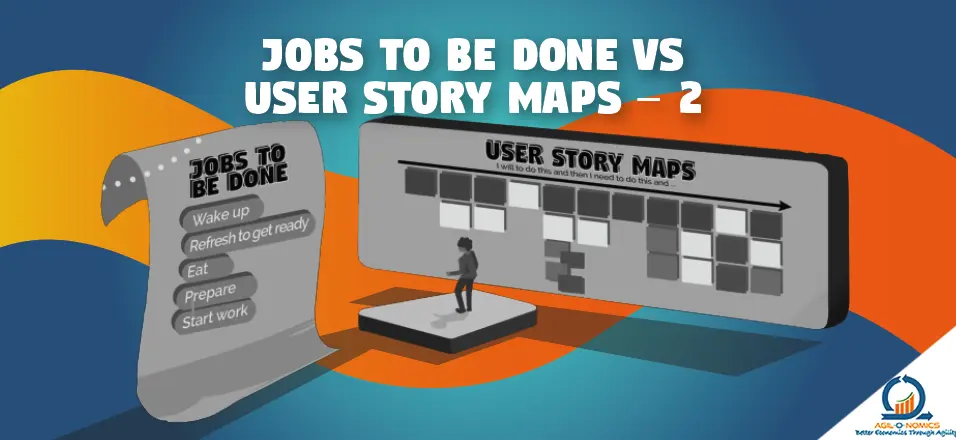
Jobs To Be Done vs User Story Maps – 2

This is part 2 of the article on JTBD vs. USM For part 1 of the article, please refer to …… Jobs To Be Done vs User Story Maps In this article, we will fully dive deep into what Jobs To Be Done (JTBD)  really is and how it differs from User Story Maps. I will also help show how to use them collaboratively in meeting your needs. JTBD first came out when Clayton Chirstiansen, a professor at Harvard Business School’s Product Management group, set out with his team to understand what ‘needs’ drive people to ‘hire’ a product. Needs are driven by “jobs that need to be done”. In short, Clayton and his team ended up interviewing a number of people buying Milkshakes at a fast food restaurant. They asked each Milkshake buyer, “What jobs do they need done that makes them hire a milkshake?”  While many did not understand what the question really meant, Clayton’s team through observation and talking with customers figured out that people who had to commute long distances early AM needed to buy milkshakes to keep them full till lunch, to have something that takes quite a while to consume, to have something that is easily manageable while driving through the commute……. And that, they were not necessarily buying milkshakes because they were delicious. Here is the video where Clayton talks about Milkshakes! This and other experiments made Clayton and his team conclude that people hire a product because they have a certain job that needs to be done.  This is quite revolutionary.  “The secret to right innovation lies in understanding what causes customers to make choices that help them achieve progress on something they are struggling with in their lives. To get to the right answers, Christensen says, executives should be asking: “What job would consumers want to hire a product to do?” So, in summary, JTBD: User Story Maps (USM) on the other hand, is based on users and their experiences while using a product. USM focuses on specific personas and their story on how they (want to) use your product. A good user story map contains not only the journey but also the experience – challenges, pains, awards and joys the users feel or express while using your product. Although, the USM has no specific set of rules, it is recommended to understand the difference between the sea-level “user steps” (a step that a user takes in the journey of using your product with the intention of completing it once started) and the “backbone” – activity or higher level summary of a group of steps as shown in the image below Fig. xxx – User Story Map for an Air Travel App While both the sea level (user steps) and backbone (higher level summary) are in narrative flow, the backbone actually represents the jobs to be done and provides insights into the deeper needs of customers or users.  The narrative flow of sea level user tasks goes like this: (As a user of this product)  I will do this , and then I will do this, and then I will do this and then…. The narrative flow of backbone (user activity) goes like this: (As a user that wants to get this job done – air travel in this case)  I need to do this , and then I need to do this , and then I need to do this and then … Please refer to the examples below illustrating the above: Looking at these images, one can easily see that jobs to be done are already embedded into the user story maps. Many do not know how to create story maps effectively. If you can build your maps wisely and mark out areas or steps where customers and users experience challenges, pains and have to work around to get through those step(s), you will be able to draw insights on what they want to get done and what needs are not being met for which they have workarounds. Clayton himself has said: “For me, this is a neat idea,” Christensen writes of the Theory of Jobs to Be Done. “When we buy a product, we essentially ‘hire’ something to get a job done. If it does the job well, when we are confronted with the same job, we hire that same product again. And if the product does a crummy job, we ‘fire’ it and look around for something else we might hire to solve the problem.” Many folks who have never experienced story maps and their effectiveness and usefulness in creating delightful products, but know about Jobs To Be Done, use this thinking framework to draw insights. However, they will still need to create some sort of visual alignment for conversations to build a shared understanding.  ou cannot just use JTBD on its own to help others understand a product. Remember, JTBD is a motivation and not a product design! However, people who employ user story maps can easily draw out the jobs to be done Comparison between Jobs to be done vs. User Story Maps  Conclusion:  There’s quite a bit of debate out there on what is a better approach for building a great product, Jobs To Be Done Or User Story Maps. The reason for the debate is due to a lack of proper understanding of how these two approaches work. Looking deeply and objectively, one will find that they are not conflicting but are different ways to understand your customers and user’s real problems and goals, which is part of a good product thinking exercise. A user story map will ideally have included the important jobs a user needs to be done Amitabh (Amit) Sinha is a servant leader entrepreneur, visionary, mentor, trainer and coach. Amit is highly passionate about Agile, its principles, values, and the human side. Amit is a people champion and strives to bring out the best in his teams. Amit leverages his expertise in Agile, Scrum, Kanban and people skills to increase team effectiveness and happiness. See more

Transform Your Team, Elevate Your Business!

Subscribe to the Agilonomics Newsletter and Claim Your Free Power Team Consultation Today!

We promise to keep your email address safe. You can check our Privacy Policy.

Thank you for subscribing to our Agile Wisdome - Weekly Tips!

You’re almost there! Please check your email and click the confirmation link to complete your subscription. If you don’t see the email, be sure to check your spam folder.

Privacy Overview

This website uses cookies so that we can provide you with the best user experience possible. Cookie information is stored in your browser and performs functions such as recognizing you when you return to our website and helping our team to understand which sections of the website you find most interesting and useful.

Strictly Necessary Cookies

Strictly necessary cookies are enabled at all times so that our website can function optimally.

3rd Party Cookies

Our website uses Google Analytics to collect useful information. These cookies are used by us to build a profile of interest and show you relevant offers.

Keeping these cookies enabled helps us to improve our website and your experience.